送信者: "The Data Drop" <akash@sheets.works>
宛先: ghjkhjgkjghk@withoutemail.com
日付: 2026-08-18T19:38:44.000Z
Tips used to be drink money
:root { color-scheme: light; supported-color-schemes: light; }
body { margin:0; padding:0; -webkit-text-size-adjust:100%; background:#FFFFFF; }
table { border-collapse:collapse; }
img { display:block; border:0; outline:none; text-decoration:none; }
a { color:#111; }
.jak { font-family:'Plus Jakarta Sans',system-ui,-apple-system,'Helvetica Neue',Arial,sans-serif; }
.mono { font-family:'Roboto Mono',ui-monospace,Menlo,monospace; }
u + .body .force-paper { background:#FFFFFF !important; color:#111 !important; }
[data-ogsc] .force-paper { background:#FFFFFF !important; color:#111 !important; }
@media (prefers-color-scheme: dark) {
.force-paper { background:#FFFFFF !important; color:#111 !important; }
.force-ink { color:#111 !important; }
.force-mut { color:#666 !important; }
}
@media only screen and (max-width:640px) {
.container { width:100% !important; }
.inner { padding-left:26px !important; padding-right:26px !important; }
.hook { font-size:24px !important; line-height:1.4 !important; }
.btext { font-size:18px !important; line-height:1.62 !important; }
}
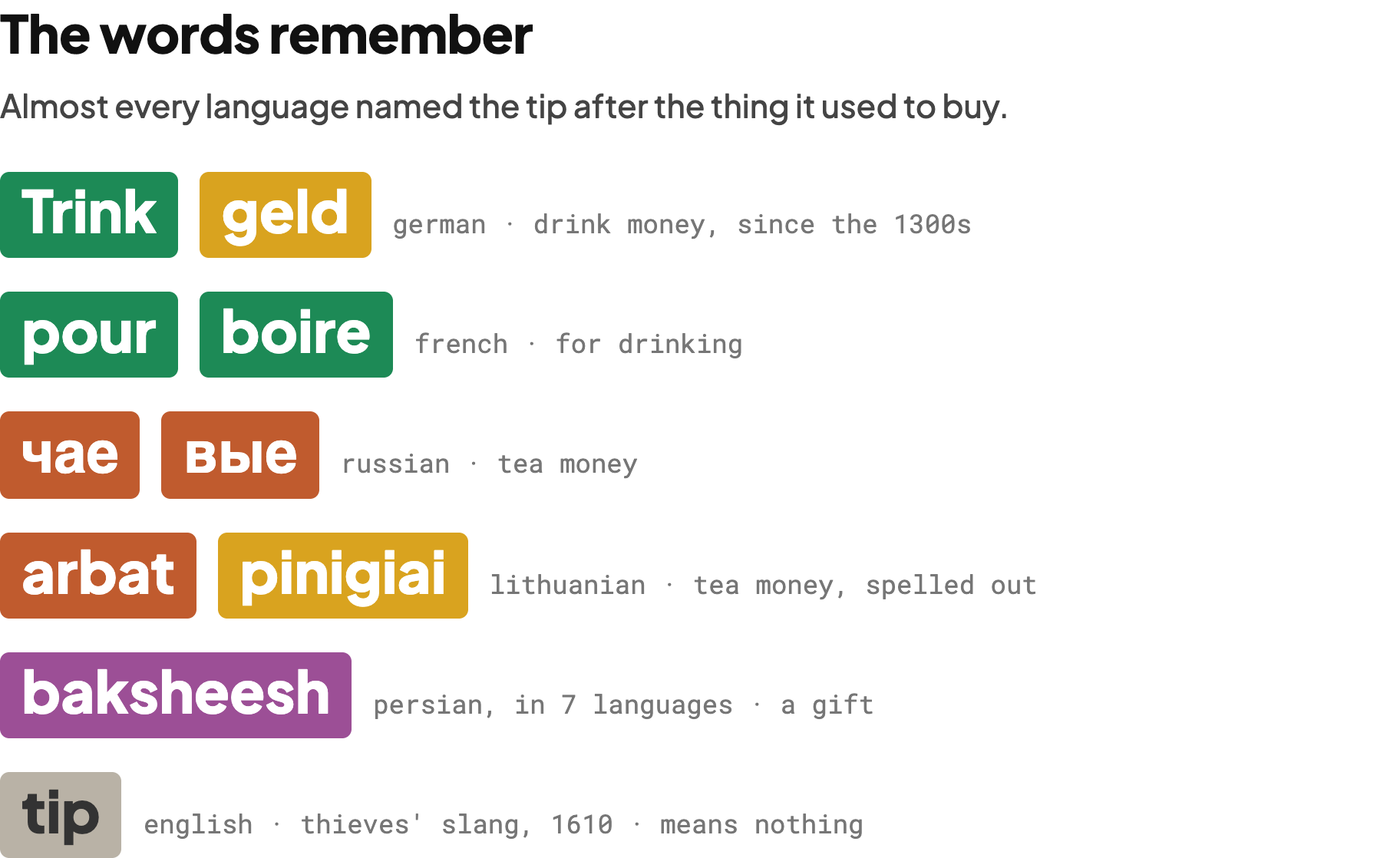
The German word for a tip is drink money. So is the Danish one. And the Finnish one.
Tips used to be "drink money."
I spent an evening on r/tipping this week, a subreddit where 185,000 people argue about tips. A banquet server there was furious with her own colleagues. Guests ask for tap water. The colleagues bring $4.50 bottles instead, because the tip on a bottle is 80 cents. Somewhere in there I started wondering where this whole arrangement came from.
The habit is four hundred years old. In the big houses of England, a guest paid the servants on the way out. A coin to the footman who fetched your coach, another to the man who held your horse. They were called vails, and they were never wages. The coin bought the servant a drink once you were gone.
The drink is not a guess. It is written into the words. The German for tip is Trinkgeld. Drink money. The Danish word also means drink money. So does the Swedish one. The Finnish one is the German word translated piece by piece. Polish says beer. Hungarian says wine. Russian says tea. Thailand's traditional word means "the cost of hot water and tea". I checked 37 languages. Most of them are buying somebody a drink.
The odd one out is English. "Tip" is thieves' slang from 1610 for handing something over. It says nothing about what the money is for, which left it free to become anything. In America, after the Civil War, restaurants and railway companies hired freed Black workers and let the customers' coins stand in for pay. Congress made the arrangement law in 1966. The federal cash wage for a tipped worker has been $2.13 an hour since 1991. I checked that date three times.
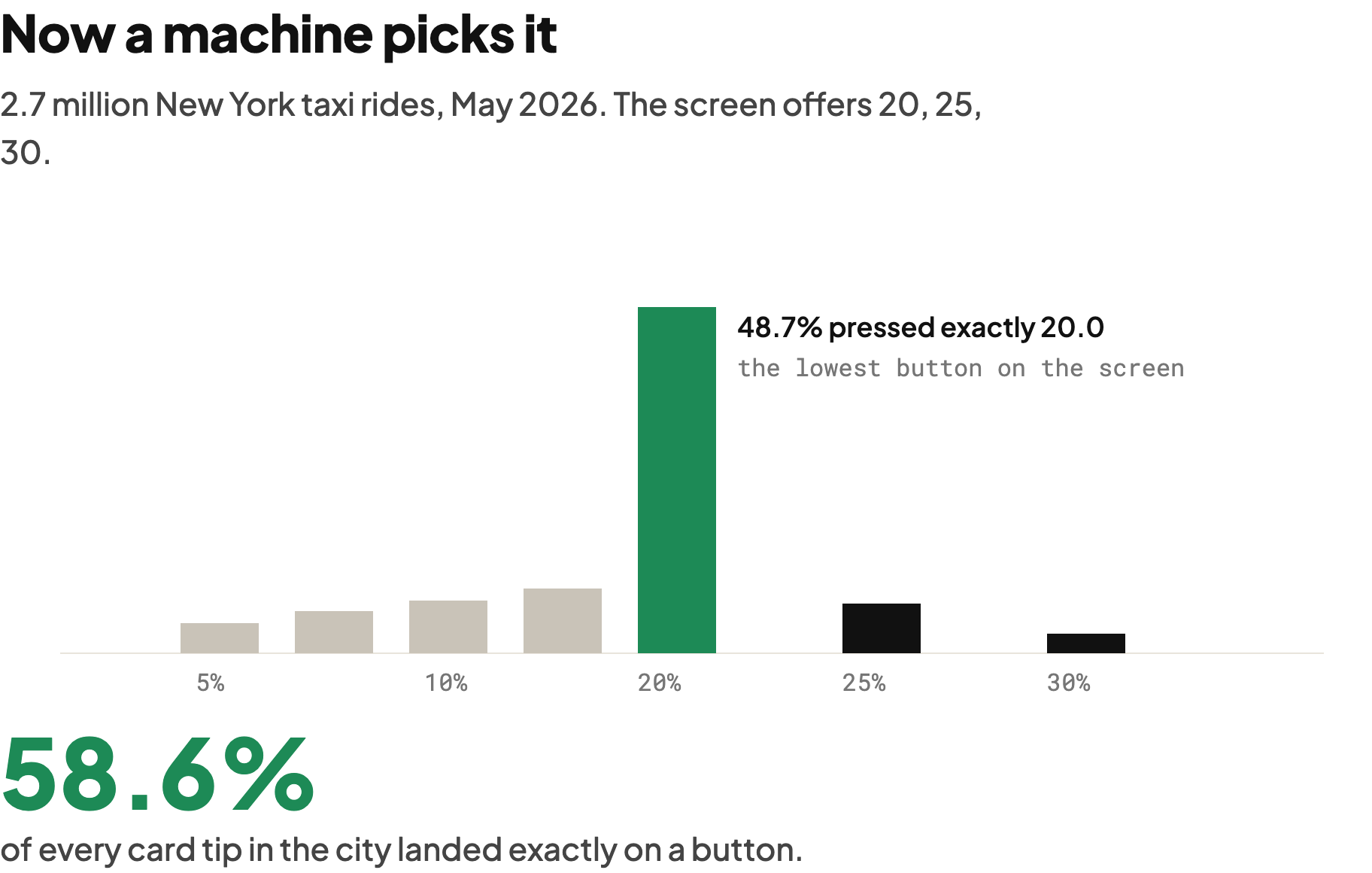
Then I wanted to know who actually decides a tip any more, so I downloaded a month of New York taxi rides. 2.7 million of them. 48.7 percent of the card tips were exactly 20.0 percent. Not around 20. Exactly. It is the lowest button on the back-seat screen.
Two facts I now tell everyone: when England tried to abolish tipping in 1764, the footmen rioted at Ranelagh Gardens with drawn swords. And in 2017, Maine's servers marched on their statehouse to bring the tip credit back, and won. Both times, the tipped defended the tip.
Read the whole culture →
I make one of these every week. The bigger builds, and the stories that never make the newsletter, live in the Hidden Tab. A few dollars a month.
And if you still haven't tried Long Story Short, our daily word game, today's sentence is a good one.
What does your language call the tip? Hit reply, I read every one.
Akash
Tipping, a culture · a sheets.works data drop
You're getting this because you signed up for The Data Drop at sheets.works.
Unsubscribe
·
All drops